


You step out, water drips, the mat decides how dry your feet feel. In 2026, the question still matters: cotton or microfiber bath mat—Which Absorbs Better?
This clear guide shows what “better” means in practice: faster uptake, higher capacity, quicker drying, and cleaner hygiene. You’ll learn how to test at home and choose the variant that performs better for your routine and bathroom setup.
Absorption mechanics: fibers that do better
“Better” absorption has two parts: how fast water disappears and how much a mat holds before feeling soggy. Fiber chemistry and structure drive both results.
- Hydrophilic cotton (cellulose) attracts water into each fiber; loops and pile create voids that store droplets.
- Split microfiber (polyester/polyamide) forms micro-channels; the huge surface area wicks water fast across the pile.
- Loop vs chenille vs cut pile determine both uptake speed and storage capacity per square inch.
- GSM (grams per m²) and pile height are reliable proxies: denser, taller piles generally hold more overall.
Microfiber (also spelled “microfibre”) can wick quicker than cotton of equal weight due to capillary action along split filaments.
If your “better” means the floor gets dry faster after a shower, microfiber often edges ahead. If “better” means maximum water held per mat before saturating, thick cotton loop piles can compete or win—especially at high GSM.
- Microfiber chenille fingers = many channels, rapid uptake at the contact point.
- Cotton terry loops = strong reservoir; slower to wick laterally but robust storage.
- Backing matters: foam cores add capacity but may slow drying; thin woven backings drain faster.
- Blend ratios (e.g., 80/20 microfiber) influence both wicking and hand-feel.
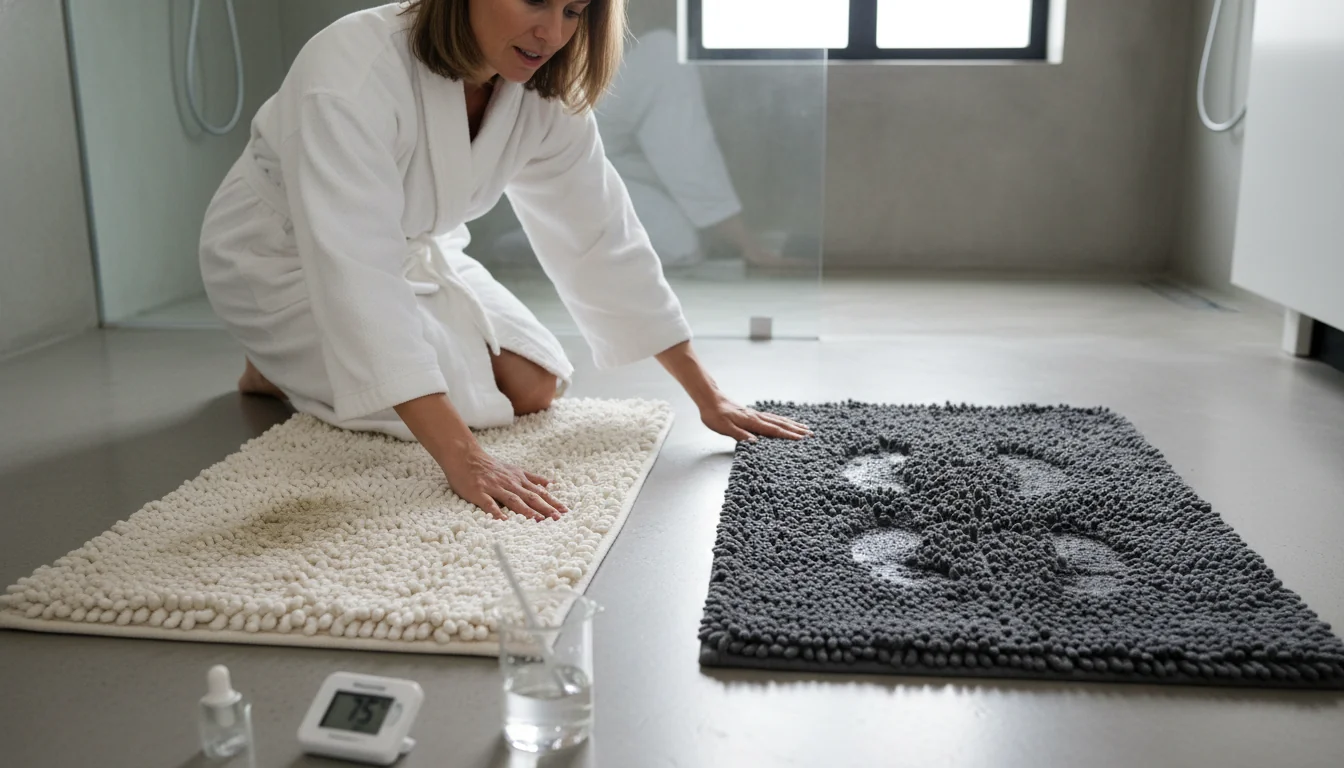
Compare “better” by touching: press a damp palm on each mat. The one that clears moisture quicker is better for wicking; the one that still feels springy after multiple presses is better for capacity.
Bottom line for mechanics: microfiber often performs better for instant pickup; heavy cotton often performs better for deep storage. Your priorities decide which absorbs better for you.
Speed vs capacity: what’s better daily
In real bathrooms, “better” depends on routines. Think shower frequency, people per hour, and ventilation. Absorption that suits a solo morning shower may underperform in a busy household.
- Single-user routine: microfiber is often better—fast uptake, drier floor, quick recovery.
- Back-to-back showers: higher-GSM cotton can be better—greater reservoir delays saturation.
- Low ventilation: microfiber is better—shorter drying time lowers mustiness risk.
- Splash-prone zones (kids, pets): microfiber’s spread-wicking contains puddles better at the edges.
| Performance factor | Tends to be better |
|---|---|
| Initial uptake speed (first contact) | Microfiber (split filaments) |
| Total hold before saturation | High-GSM cotton loop piles |
| Recovery time between showers | Microfiber (faster drying) |
| Long-term odor resistance | Microfiber (with regular care) |
A thick cotton mat can feel “better” during heavy use—but only if it fully dries within 24 hours. Otherwise, expect lingering damp and compressed pile.
If you want to compare other shapes and textures against this daily-use logic, browse a wider bathroom mat selection to visualize how construction shifts real-world outcomes.
In short, a microfiber chenille mat is usually the better sprinter; a dense cotton loop mat is often the better marathoner. The best choice is the one aligned to your throughput and drying window.
Drying and hygiene: the better pick
Absorbency only counts if the mat releases moisture later. “Better” here means shorter drying time, less odor, and a fresher feel after repeated cycles.
- Microfiber dries faster due to finer fibers dispersing water over more surface area.
- Cotton retains more within each fiber and loop; dry thoroughly to avoid musty smells.
- Backings: TPR/latex grip is safer but slows airflow; hanging the mat boosts drying for both types.
- “Better hygiene” often tracks with faster evaporation and frequent laundering.
Avoid fabric softener on microfiber; it coats fibers and reduces wicking. For cotton, a vinegar rinse restores absorbency.
Large bathrooms or double-vanities? Extra surface can be better than raw density. Consider oversized rug bath mats to spread load, speed drying, and reduce re-wetting.
OEKO-TEX labels address chemical safety, not performance. Absorbency still depends on fiber, GSM, and pile.
For hygiene-centric households, microfiber often proves the better choice. For plush comfort with strong capacity, high-GSM cotton can be better if you ventilate and rotate mats.

Comfort and safety: better underfoot
Absorbency alone does not make a mat better. Underfoot feel and grip when wet matter just as much—especially for children or older users.
- Cotton loops feel plush, warm, and familiar; they excel when you want cushion with capacity.
- Microfiber chenille feels velvety and springy; fingers flex to trap drips while staying soft.
- Anti-slip backings (TPR/latex) improve safety but slow drying—air them well after use.
- Edge stability: overly thick foam cores can curl and become a trip risk if not dried flat.
“Better” grip means less slip on tile—not just a heavy mat. Check backing condition regularly; replace if glazing reduces traction.
If aesthetics weigh into what feels better to you, browse design-led bath rugs to balance texture, color, and safety with the absorption profile you prefer.
“The better mat is the one that dries your feet fast, dries itself faster, and never surprises you underfoot.”
Home test: prove what’s better
To compare which absorbs better in your bathroom, use similar sizes and test after the same shower routine. A grey cotton loop piece like this cotton example works well as a control against microfiber chenille.
- Weigh each dry mat (kitchen scale).
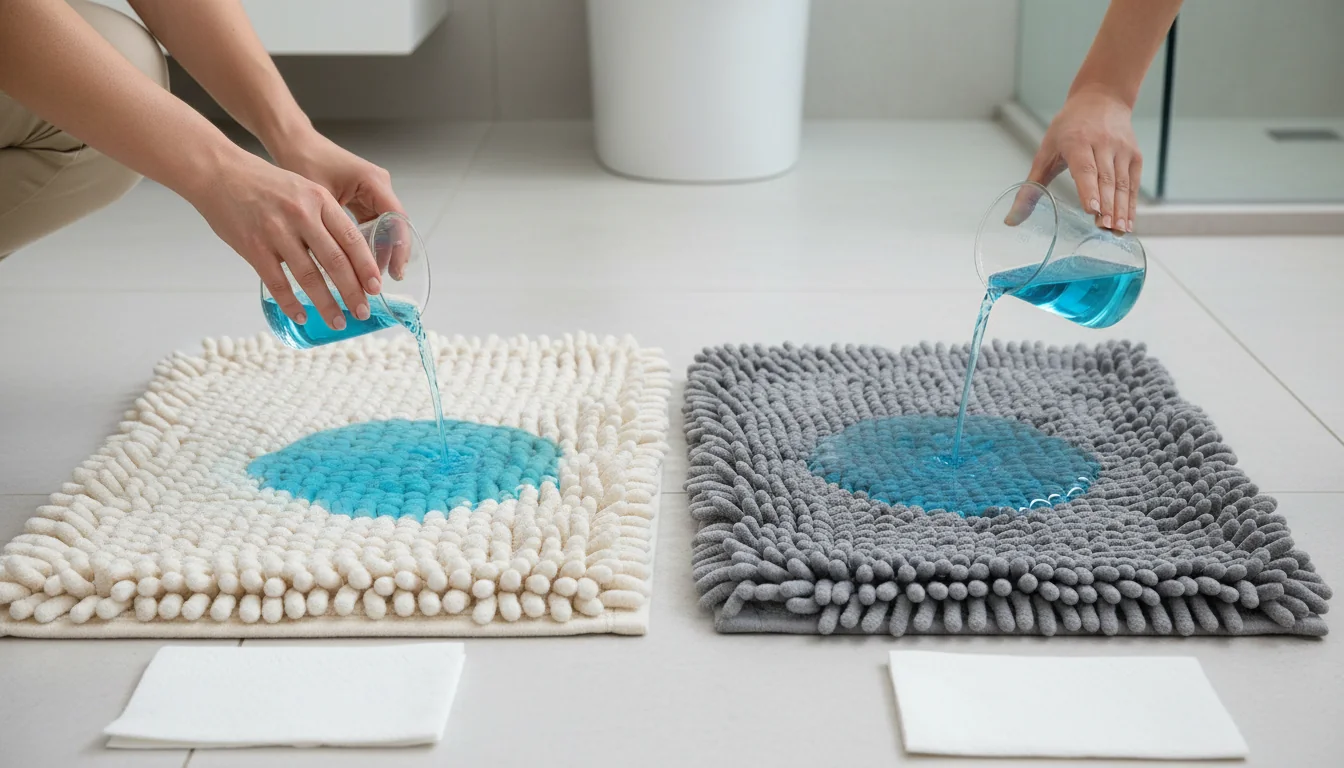
- Simulate drips: pour 150 ml water over 10 seconds.
- Wait 60 seconds; blot your foot on each once.
- Weigh mats again; higher gain = more capacity.
- Time to “touch-dry” (no cool damp feel) for drying speed.
If slip-resistance is part of “better” for you, compare against a cotton mat with non-slip base to isolate grip from absorbency.
- Interpretation: faster touch-dry = better for quick resets; higher weight gain = better for pooling events.
- Run the test twice: once after laundry and once after a week of use to see real aging.
- Laundry control: avoid softeners and dryer sheets when testing microfiber accuracy.
Color won’t change absorbency, but fabric density and loop type will. For variety in test conditions, a blue terry variant like this cotton option can reveal how loop geometry affects capacity.
Keep mats off radiant floor heating during tests; heat skews drying-time comparisons and may degrade certain backings.
FAQ: deciding what’s better
Why choose what’s better for me, not in general?
“Better” can mean speed, storage, or drying. Microfiber is usually faster; cotton can store more. Match to your shower cadence, ventilation, and safety needs for the most relevant upgrade.
How does microfiber compare to thick cotton in practice?
Microfiber wicks faster and dries sooner. Dense cotton loop mats often hold more but need longer to air out. A white loop reference like this cotton piece is a good baseline when testing against chenille.
What are the advantages of the “better” fast-dry route?
Faster resets between showers, fewer damp footprints, and lower odor risk. If you host often, the quick-dry profile is usually the smarter interpretation of “better.”
Is a larger mat a better idea than a denser one?
Often yes. More surface spreads load and speeds evaporation. If ventilation is modest, larger coverage can be better than sheer thickness for day-to-day freshness.
How do I maintain absorbency over time?
Wash at 30°C, use mild detergent, skip softeners (especially for microfiber), and tumble low or air-dry. Periodic vinegar rinses help cotton regain loft and absorbency.
Does color affect which absorbs better?
No. Absorbency depends on fiber, GSM, and pile. Color only affects care nuances (e.g., avoid bleach on darks). Choose hues that suit lighting and cleaning routines.
So, cotton or microfiber bath mat: which absorbs better? Microfiber is typically better for fast uptake and quick resets; dense cotton can be better for deep capacity if you allow full drying.
- Define “better”: speed vs capacity vs drying time.
- Match to routine: airflow, back-to-back showers, safety.
- Test at home: weigh, time, and feel underfoot.
For a familiar cotton benchmark, consider this classic cotton bath rug as your control when comparing against microfiber in your 2026 setup.
0 comments