


Red Bath Mat


Slippery tiles, damp footprints, and color fade are daily frustrations—yet they are solved by a purpose-built bath mat. In this collection, the emphasis is the mat itself: the construction underfoot, the non-slip base, and the way a calibrated red surface defines the wet zone. A red bath mat is more than color; it is engineered coverage where water lands first.
Below, you’ll find how the mat differs from a bathroom rug, why grip mechanics matter, and how pile density, GSM, and backing types influence drying rates and stability. You’ll also see which red shades work best around showers, basins, and tubs. Scan the guides, compare specs, and choose a mat that keeps floors dry, steps steady, and reds vivid over time.
Ready to refine your bathroom’s wet-zone control? Browse the insights, then select a mat with the right size, material, and shade for your space.
A mat is a technical tool first. Unlike decorative bathroom rugs, a bath mat prioritizes non-slip traction, immediate water uptake, and predictable placement at the tub, shower, or sink. The best mats combine surface fibers that wick quickly with a base that resists lateral movement even when saturated.
While plush textures feel indulgent, the mat’s advantage is measurable: consistent grip when wet, focused placement, and wash cycles that restore loft. That’s where it outperforms alternatives that favor softness over stability.
| Criterion | Bath Mat | Bathroom Rug |
|---|---|---|
| Primary purpose | Wet-zone control, traction, quick absorbency | Decor, warmth, secondary absorbency |
| Backing type | Full TPR/latex/rubberized base, non-slip rated | Often woven or cotton base, variable grip |
| Best placement | Outside shower/tub, in front of sink | Open floor areas, layering |
| Wash frequency | High-frequency machine washable cycles | Moderate, may require spot-care |
For slick tiles, prefer mats with full-contact backing rather than dots. Test traction by stepping with wet feet: zero lateral slide is the benchmark.
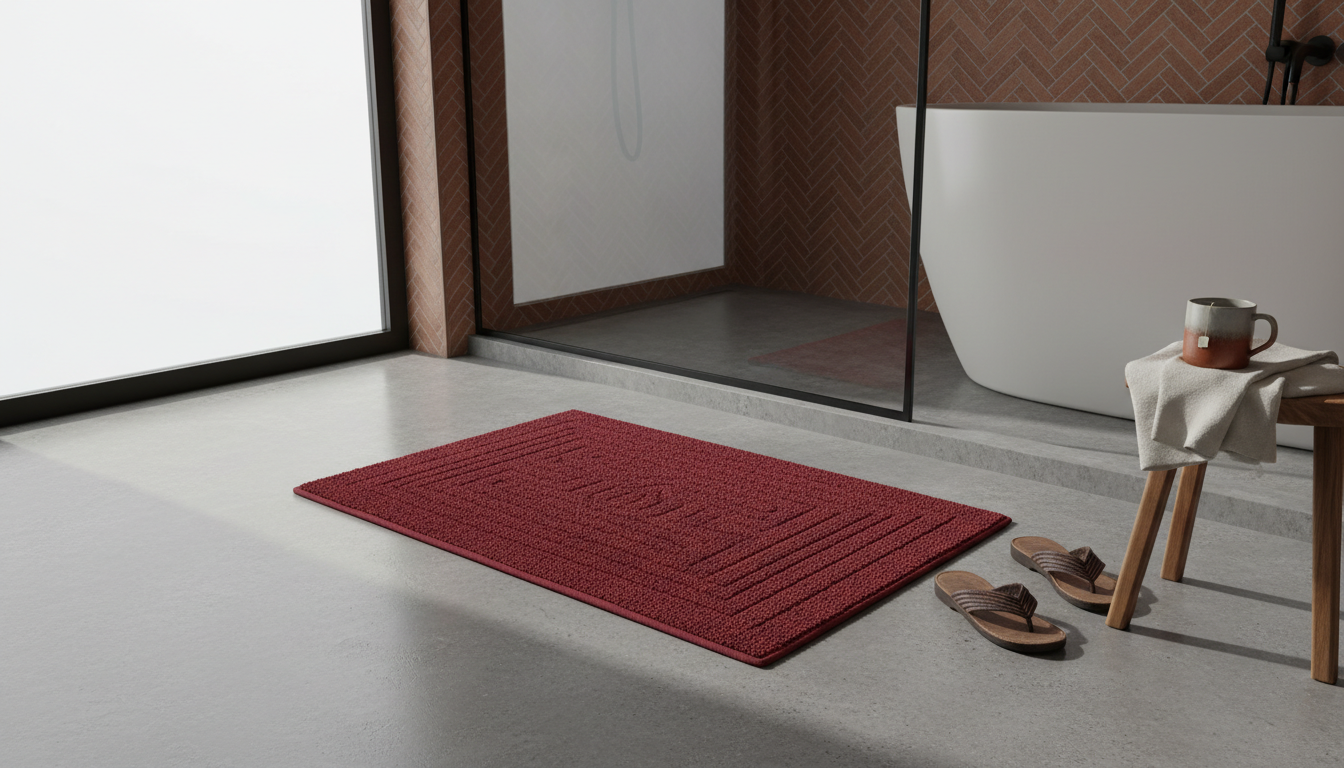
Because a mat sits where water hits first, its red tone becomes the visual anchor for the wet zone. Red, as an accent underfoot, adds warmth without overwhelming the room. The concentrated footprint of a mat lets you use bolder hues than you might attempt on walls or towels.
Unlike larger rugs that dominate a floor, a mat’s proportion focuses attention at entry points: tub edge, shower door, and vanity. This strategic placement turns red into a controlled accent that guides traffic and highlights safety.
| Shade of red | Pairs with | Maintenance note |
|---|---|---|
| Deep red | Charcoal grout, dark oak, brushed nickel | Hides droplets; lint-roll darker fibers after drying |
| Bright red | Glossy white tile, polished chrome, light maple | Shows dust faster; shake daily for crisp look |
| Wine/garnet | Marble veins, linen neutrals, patinated brass | Use colorfast detergents; wash cold to preserve depth |
Novelty color-changing mats exist that appear light and then turn red when wet. Fun as they are, a true bath mat still needs reliable traction and repeatable washing performance.
If you’re mapping color across the whole room, compare red accents underfoot with neutrals, textiles, and storage accessories in the wider bathroom range to balance saturation and contrast gracefully.
Material choice decides how a mat behaves day after day. Fiber structure, pile height, and density (GSM) dictate how fast a mat absorbs, how it dries, and how it holds dye.
| Material | Typical GSM / Build | Absorbency & Drying | Wash Care |
|---|---|---|---|
| Cotton terry (tufted) | 700–850 gsm, loop pile | Highly absorbent, moderate dry time | Cold to warm wash; low heat dry; avoid bleach |
| Chenille microfiber | Dense yarn “noodles” | Fast uptake; quick-drying | Gentle cycle; air or low tumble |
| Memory foam core | Foam layer + textile face | Comfort-first; slower to dry if very thick | Check label; ventilate thoroughly between uses |
| Nylon blend (thin) | Lower GSM, flat weave | Moderate absorbency; very fast dry time | Machine wash; dries quickly |
Preserve colorfast reds by washing cold with like colors. Use mild detergents, avoid optical brighteners, and skip fabric softener on chenille to maintain loft and absorbency.
If daily splash zones are heavy, review the absorbent choices that emphasize higher GSM loops and dense yarns—precisely the traits a mat needs to keep floors dry between showers.
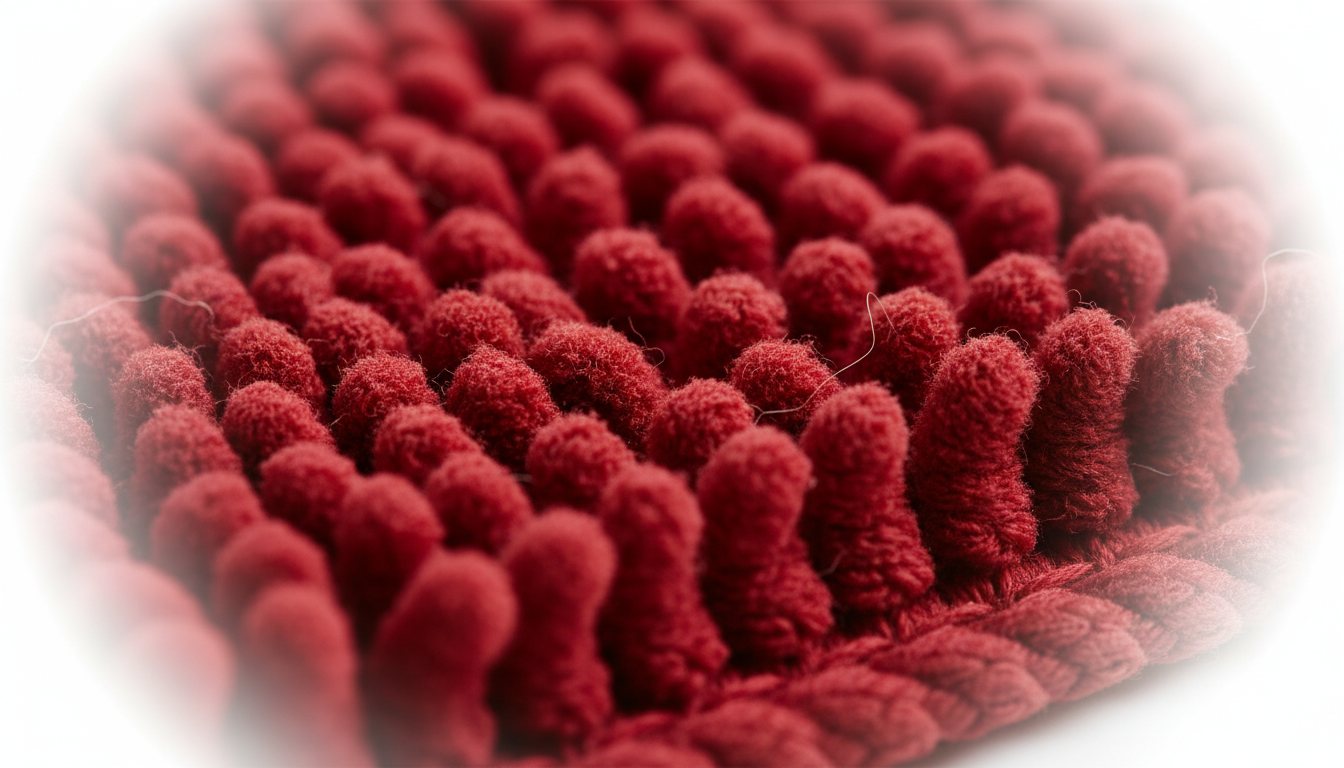
Because a mat is narrower than a full rug, its shape and size must match your fixtures. A smart fit keeps toes on dry fibers and ensures the backing contacts the floor fully, maximizing grip.
| Fixture/Area | Recommended mat size | Notes |
|---|---|---|
| Shower door | 20 × 31 in / 50 × 80 cm | Place hinge-side to catch door drip path |
| Tub edge | 21 × 34 in / 53 × 86 cm | Center on step-out point; extend beyond tub lip |
| Pedestal sink | Semicircle 20–24 in wide | Curved edge tucks close to base; reduces trip edges |
| Double vanity | Runner 20 × 60 in / 50 × 150 cm | Uniform grip along the sink line matters most |
The mat’s footprint should align with the wet footprint. Oversized mats can fold; undersized mats leave drips exposed.
Considering mixing accents? Explore neutral grey alternatives to pair one red mat near the shower with a muted tone under the vanity for balance without diluting the focal point.

Selecting the right mat is a technical choice—material, base, GSM, and exact size define performance. Here’s a concise framework for a dependable decision.
Need statement coverage by the tub? Consider an oversized red option that keeps both step-out points inside the absorbent zone.
| Use case | Recommended mat spec |
|---|---|
| Daily family shower traffic | Chenille microfiber, full TPR base, 20 × 31 in |
| Spa-like sink comfort | Memory foam core, ventilated base, semicircle profile |
| Heavy splash by tub | Terry tufted 800–850 gsm, 21 × 34 in |
For plush daily comfort with fast uptake, a red chenille option gives a thick, velvety feel while maintaining quick-dry behavior between morning routines.
Curved basin? A half-moon format in red tucks to the pedestal, minimizing exposed edges while spotlighting the sink zone.
A mat is built for wet-zone safety: non-slip backing, tight footprint control, and wash cycles that restore absorbency. The red accent stays where it matters—by the shower, tub, or sink—delivering traction and fast moisture capture with less bulk than a general rug.
Runners extend coverage along vanities, while a single mat targets the splash zone precisely. Sets add toilet covers or U-shaped pieces; a standalone mat remains the most efficient way to combine grip, absorbency, and vivid color in the highest-risk area.
Higher GSM (e.g., 800–850) increases water uptake per step and improves underfoot warmth. Bound edges reduce fray; full-coverage backing boosts stability on slick tiles. The mat’s compact surface concentrates both safety and color impact where feet land.
Yes. A tight footprint like a 16 × 24 in piece anchors the shower exit without crowding doors. For tiny spaces, see a compact format that maintains traction while keeping thresholds clear.
Wash cold with similar hues, avoid bleach, and use mild detergents. Air dry or tumble low to protect fibers. Certifications such as OEKO‑TEX STANDARD 100 indicate materials screened for chemical safety, helping preserve colorfast fibers over repeated cycles.
A rectangular mat matching the door width captures drips from the seal line. For threshold-free entries, pick a low-profile piece with strong base adhesion, like a ventilated option in the walk-in shower category.
A red bath mat concentrates safety, absorbency, and design exactly where water meets tile. By prioritizing stable backing, fiber density, and the right shade for your lighting, you gain a durable accent that works every day. Compare sizes, materials, and wash care above, then choose the mat that precisely matches your bathroom’s wet footprint.


