


Why do the properties of a mineral decide how fast a floor dries, how clean an oil spill gets, or how a filter runs? Because material behavior rules performance. In 2026, understanding diatomite means understanding its properties first.
This article explains diatomite: definition, origin, and absorbent properties with practical clarity. You will see how microstructure drives uptake, how heat treatment changes performance, and how to match a grade to a task.
Have a bathroom, workshop, or lab in mind? Keep reading to link these properties to outcomes you can measure.
Water uptake: pore architecture
Diatomite—also called diatomaceous earth or kieselguhr—is a rock built from fossil diatom shells (frustules) of amorphous silica. Its absorbent performance comes from its intricate, open pore network and capillaries.
- Open porosity drives high void volume, enabling rapid uptake of water and humidity.
- Micron-scale channels deliver strong capillary rise for quick surface drying.
- Low bulk density increases pore volume per gram, boosting absorption capacity.
- Irregular frustule shapes interlock, improving stability while holding liquid.
Look for consistent particle grading; tighter size ranges yield steadier absorption and faster surface recovery.
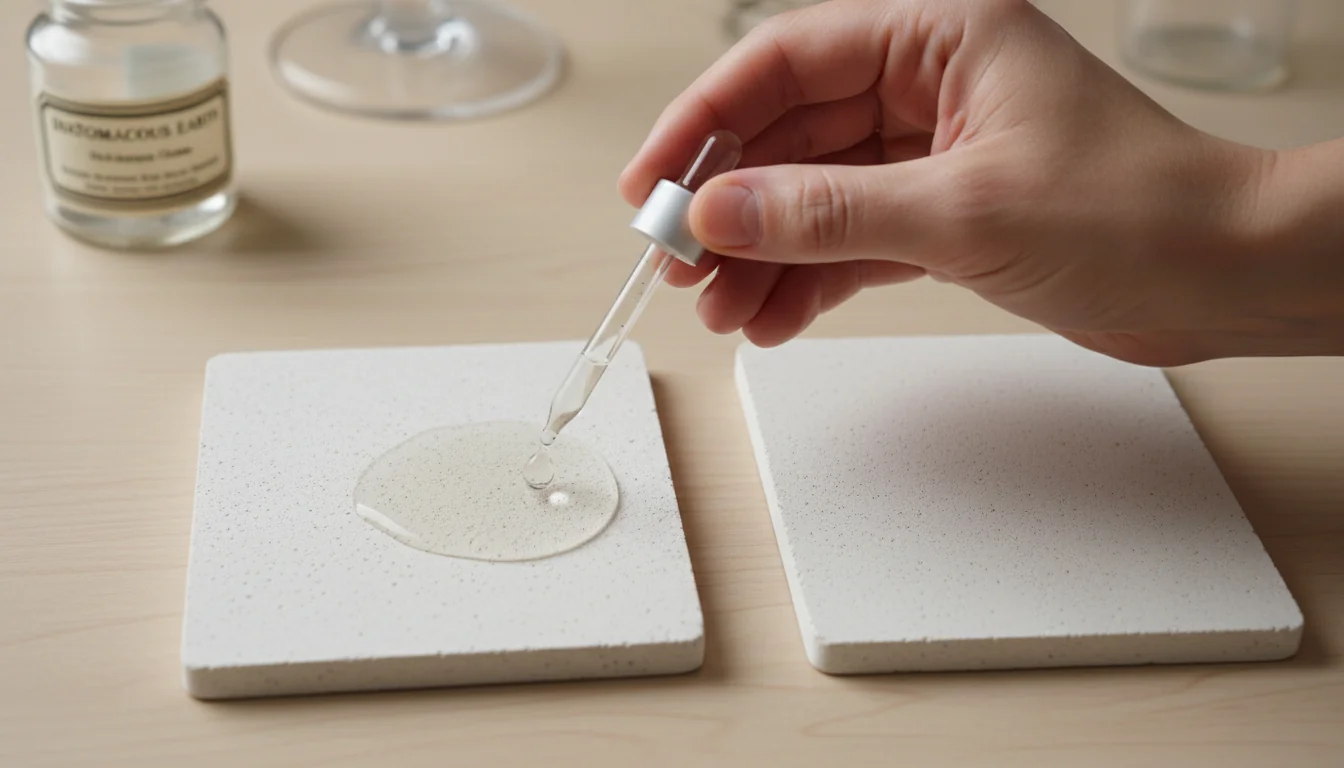
These properties explain why thin, rigid panels of diatomite can draw moisture away quickly while staying dimensionally stable—unlike sponges that sag or swell. That balance is the foundation of its absorbent properties in everyday use.

Surface chemistry: hydrophilic to oleophilic
Raw diatomite is hydrophilic because of silanol (Si–OH) groups that attract water. Modify that surface, and you re-direct its affinity—this is how you tune properties for water or oil spills.
- Hydrophilic grades excel at rapid water uptake and humidity control.
- Hydrophobized grades (e.g., methyl- or silicone-treated) target oils and organic liquids.
- Calcined diatomite improves strength; surface treatment refines selectivity.
- For chemical spills, diatomite appears in “acid binders” and “universal binders” alongside sawdust; it absorbs rather than neutralizes.
Absorbents don’t neutralize strong acids. After uptake, handle residues per your safety protocol.
Industrial literature notes hydrophobic formulations—such as calcined diatomite treated with around 20% methyl polymer—shifting preference toward oils. This targeted tuning shows how surface chemistry refines absorbent properties for specific tasks.
Flow-through: permeability and grading
Absorbent performance is not only “how much” liquid it holds; it’s also “how fast” it wicks and “how evenly” it dries. Those properties depend on permeability, particle size, and processing route.
| Grade | Key attributes |
|---|---|
| Raw (natural) | High porosity; lower strength; good wicking for water; pH near neutral. |
| Calcined | Improved rigidity; stable pores; faster surface recovery; good for panels and mats. |
| Flux-calcined | Higher strength; slightly altered pore geometry; used when abrasion resistance matters. |
| Hydrophobic-modified | Repels water; oleophilic for oils/fuels; suitable for selective spill control. |
- Fine grades increase capillarity but can slow drying if over-packed.
- Coarse grades improve airflow and faster surface reset after spills.
- Blended curves often deliver the best balance of uptake and recovery.
Filter-aid grades rely on similar permeability principles. The same pore traits govern both filtration and absorbency properties.
Permeability is the hidden lever. Tune it, and you steer the material’s absorbent properties toward speed, capacity, or a balanced profile.
Thermal role: dryness and energy
Diatomite is also a lightweight thermal insulator. That trait supports dryness by keeping surfaces slightly warmer and encouraging evaporation—helpful for bathrooms and entryways.
- Thermal conductivity is low, limiting cold spots that can slow drying.
- Microporosity increases surface area, promoting evaporation after uptake.
- As a building mineral, it contributes to energy saving when used in insulating plasters and boards.
- In engineering, stable thermal behavior supports predictable moisture cycling.
Ventilate panels after heavy use. Airflow, plus low conductivity, restores dryness without heat.
These thermal and moisture-management properties move diatomite beyond simple absorption. In 2026 designs, it supports warmer-feeling, drier surfaces with minimal energy input.
Origin controls performance
Definition first: diatomite is a sedimentary deposit of siliceous microalgae remains. Origin matters; lake vs marine settings produce different frustule shapes, impurities, and deposit densities that shape properties.
- Marine sources often blend with clays or volcanic ash; these adjust pore geometry.
- Freshwater sources can yield lighter bulk density and faster capillary action.
- Interbedded layers—e.g., “basalt with interbedded clay”—alter processing steps.
- Older dictionaries list synonyms like “terre d’infusoires” and “kieselguhr,” emphasizing its biological origin.
The Dictionary of Building and Civil Engineering notes “diatomite, diatomées, kieselguhr,” aligning geological origin with names used across languages.
Deposit purity, particle morphology, and pre-existing clay all govern absorbent properties after milling and calcination. In short, origin sets the ceiling for performance.

Safety, compliance, and data sources
Diatomite is largely amorphous silica. Its properties are valued because it’s inert, stable, and effective. Yet, fine dust is a respiratory hazard; handle and cut in well-ventilated areas, following safety data guidance.
- Respirable dust: control with masks and wet-cutting when shaping panels.
- Safety datasheets group it with “universal binders” for spills; follow disposal rules.
- “Information archived on the web” in Government of Canada publications and the Patent Office Record (Gazette) documents historical uses.
- Many technical files are shared as merged PDF documents; notices like “JavaScript is disabled” on corporate portals don’t change the core data.
Amorphous silica differs from crystalline forms. Verify material specifications when assessing properties for indoor use.
Across building and civil engineering literature, and at international congress forums in geotechnical engineering, the consensus is clear: consistent characterization underpins reliable properties and safer adoption.
Guide 2026: match grade to task
Use this quick sequence to align diatomite properties with real needs. Keep steps short and test-focused.
- Define the liquid: water, oil, solvent, or mix.
- Choose surface: hydrophilic for water; hydrophobic for oil.
- Set speed vs capacity: finer for hold, coarser for flow.
- Check safety: dust control, slip risk, disposal rules.
- Run a 10-minute bench test with your fluid.
Spread a thin layer first; add more if sheen remains. Thin films dry fastest.
For bathroom drying behavior, this contemporary bath mat example shows the material’s quick-drain channels in action: a sleek diatomite slab for fast-dry floors.
Beyond soaking: secondary behaviors
Absorbency leads the story, but secondary traits often decide fit. These include thermal stability, light weight, and compatibility with additives.
- Thermal stability: silica skeleton tolerates heat better than organics
- Low density: easy handling; useful as a carrier or extender
- pH behavior: generally inert; surface acid sites influence adsorption
- Odor moderation: vapor diffusion lowers humidity at the surface
Granular diatomite appears in many safety data sheets as “acid binder” or “universal binder” for spill control.
These supportive traits round out the properties profile for 2026 applications.
What is diatomite in simple terms?
A soft rock made from fossil algae shells. Those shells are porous silica. The structure explains its strong absorbent behavior and lightweight feel.
Why do its properties make it so absorbent?
Very high porosity, hydrophilic surfaces, and capillary channels. Together they pull liquids in quickly and hold them without collapsing the skeleton.
How does calcined diatomite compare to natural?
Calcining strengthens particles and adjusts permeability. It can speed flow in filters but may slightly lower surface area for certain absorbent tasks.
Is it better for water or oil?
Both, depending on surface chemistry. Hydrophilic grades favor water; hydrophobic grades favor hydrocarbons and solvents. Pick to match your fluid.
What uptake numbers can I expect?
Typical water uptake is around 1.5–3× weight. Oils can match or exceed that. Always verify on your specific fluid and temperature.
Any safety concerns with dust?
Yes. Use dust controls and respiratory protection, especially with flux-calcined grades that may contain crystalline silica. Consult the safety sheet.
Can I reuse diatomite after drying?
Sometimes. If the liquid can evaporate and no residue remains, partial reuse is possible. For oils and contaminants, dispose according to local rules.
What’s the official definition I should cite?
A biogenic, siliceous sedimentary rock composed of diatom frustules. In many dictionaries it appears under “diatomaceous earth” or “kieselguhr.”
Diatomite’s value in 2026 rests on structure. Its pores, surfaces, and treatments convert origin into measurable absorbent performance you can plan around.
- High porosity and hydrophilicity drive fast water uptake.
- Calcination and surface tuning shift speed and selectivity.
- Match grade to liquid and safety constraints for best results.
Use these properties as your checklist, and you will get consistent, repeatable outcomes.
0 comments