


Bathroom air swings wildly after a hot shower. The goal in 2026 is not perfection—it is the correct range that protects surfaces and health without overengineering.
Do you know if your readings are reliable, and which fixes will actually bring humidity back to the right zone quickly?
In this expert guide, you will learn Ideal Bathroom Humidity: How to Measure and Correct It, with precise targets, simple instrumentation, and field-tested corrections you can apply immediately.
Healthy air: the right range
Start by defining what “correct” means for a bathroom. Aim for 45–55% relative humidity (RH) at room temperature once the room has settled for 20–30 minutes after bathing. During a shower, spikes are normal; the correct target is the post‑ventilation plateau.
- Short term: RH can hit 80–100% while steaming; ignore these peak minutes.
- After 30 minutes of extraction, RH should drift to 45–55% if ventilation is sized right.
- Persistent >60–65% beyond one hour signals that correction is required.
- Below 35% regularly? Expect dry skin, cracking grout, and dust.
Dew point matters: warming air by 2°C lowers RH by roughly 5–6 points without removing moisture. This is a fast, correct way to curb condensation on mirrors and grout.
Textiles influence readings. Freshly soaked mats keep RH elevated. Rotate, hang, and pick quick‑dry pieces from our bathroom rug range to keep the environment in the correct band more consistently.
Define success as “55% RH at 30 minutes.” If you cannot reach this, the next sections show how to correct fast and safely.

Accurate readings: methods that work
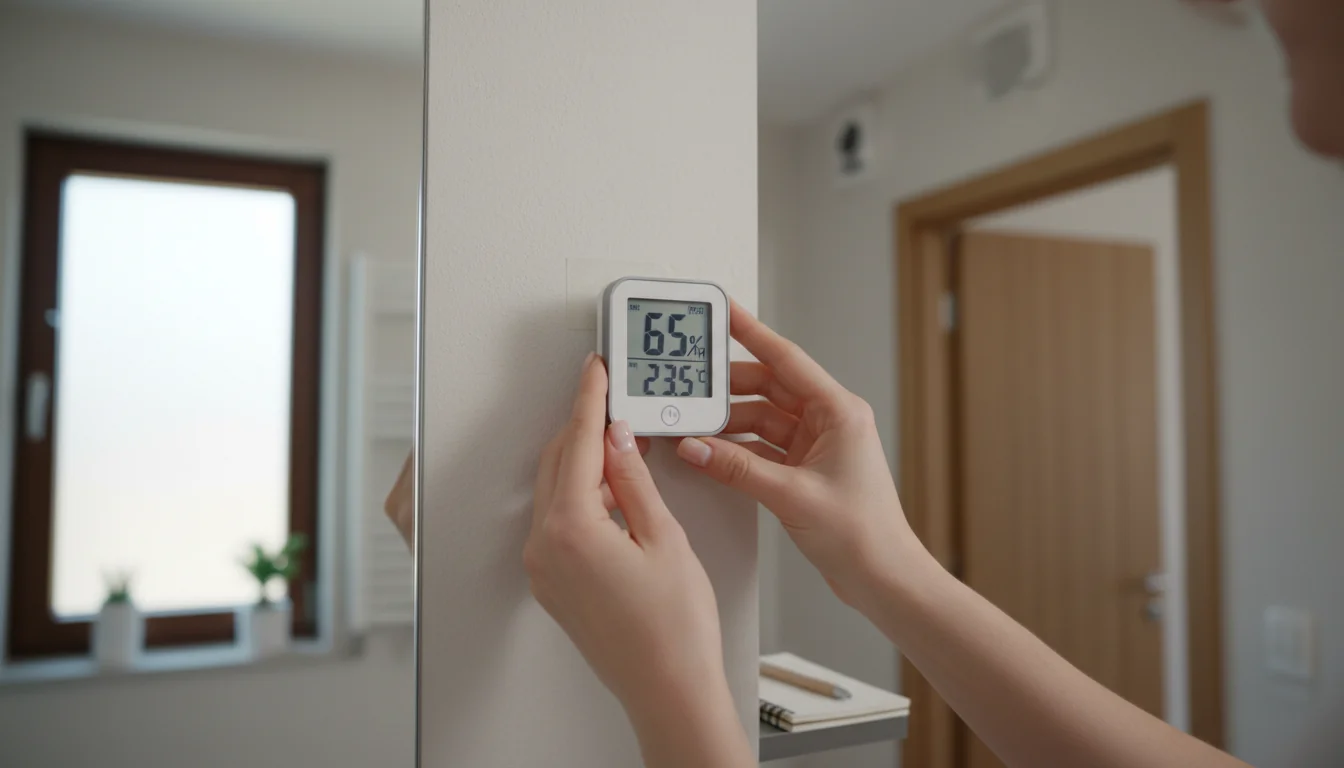
You cannot correct what you do not measure correctly. A digital hygrometer with temperature reads RH and helps you track the correct settling point after each bath or shower.
- Placement: chest height, away from the direct steam plume and windows.
- Timing: log RH right after shower end, then at 10, 20, and 30 minutes.
- Calibration: a salt‑test jar targets ~75% RH; adjust offsets if needed.
- Datalogging: a week of curves reveals whether your fixes hold the correct range.
Measurement uncertainty exists. Keep the same device, in the same spot, under the same routine. Consistency beats chasing perfect numbers; trendlines show if your correction is effective.
Large wet floor areas slow recovery. If you prefer wide coverage, choose large‑format bath mats but hang them promptly so readings reflect the correct room behavior, not lingering textile moisture.
If your hygrometer sits near a cold exterior wall, RH will read high. Move it to capture air conditions, not the cold‑surface bias, for a truly correct picture.
Moisture sources: control at the root
Correction starts upstream. Every liter of hot water adds grams of vapor. Shorten showers, reduce water temperature, and squeegee walls so your extractor does less work to reach the correct balance.
- Fix drips and seepage; even small leaks keep RH above the correct range.
- Squeegee tiles and glass to remove liquid water before it evaporates.
- Open shower doors after rinsing; move moisture to airflow pathways.
- Rotate textiles: dense piles hold vapor longer than quick‑dry weaves.
Shave 60–90 seconds off shower time and squeegee for 30 seconds. Many homes hit the correct plateau 10 minutes faster with just this habit.
Plush textiles feel great but dry slower. If you love thick textures, select and rotate plush chenille options, and hang them high so your room returns to the correct RH by the 30‑minute mark.
Cold corners and mirror edges condense first. Add a gentle heat source or improve insulation at those points to keep conditions within the correct envelope.
Ventilation sizing: airflow that fits
The most reliable correction is correctly sized extraction. Bathrooms typically need around 8 air changes per hour (ACH) during and after showers to pull RH down promptly.
- Quick rule: minimum 50 CFM intermittent or ~20 CFM continuous for small rooms.
- Better rule: CFM = room volume (ft³) × ACH / 60. Use ACH 8–10 for steamy routines.
- Account for duct losses: long or corrugated ducts need more rated CFM.
- Runtime: keep the fan on for 20–30 minutes after use or use a humidity sensor at 55–60%.
| Method | Best use |
|---|---|
| Intermittent 50–80 CFM | Small baths, light steam, doors undercut ≥10–15 mm |
| Continuous 20–40 CFM | Apartments; steady exhaust keeps RH near the correct band |
| Boost to 100–150 CFM | Large bathrooms; fast correction after long showers |
Makeup air is critical. Without a door undercut or transfer grille, fans can whine and fail to draw. No intake means no correct extraction, regardless of CFM on the box.
Verify backdraft dampers open freely, seal leaky ducts, and exhaust outdoors. Only then will your measurements confirm correct post‑shower recovery.
Surface protection: build for humidity
Even with good airflow, surfaces need defenses. Choose grout that resists water, re‑seal annually, and consider epoxy grout in the shower zone to limit absorption and keep the room within the correct humidity window longer.
- Seal grout lines every 12–18 months; inspect silicone joints quarterly.
- Use mold‑resistant paint on ceilings; sand and prime stained areas first.
- Warm surfaces: underfloor heating or a towel rail reduces condensation loads.
- Slope shelves and niches slightly to shed water to the drain.
Switch to a squeegee with a soft edge. It removes film without scratching tile sealers, supporting a correct, faster dry‑down.

Dehumidifying: fast recovery options
When extraction is limited, add a backup. A compact dehumidifier placed just outside the bathroom can pull residual moisture once the door is left ajar—bringing the space back into the correct zone faster.
- Never run plug‑in devices in wet zones; use them in adjacent, dry areas.
- Use passive desiccant tubs inside cupboards to protect linens.
- Schedule: run 30–60 minutes after showers on humid days.
- Combine with heat boost to accelerate the correct RH drop.
If your fix underperforms, do not panic. Correction is still possible. First verify the fan’s actual airflow at the grille; dirty filters and backdraft flaps often halve performance.
Step‑by‑step: measure and correct
- Place a thermo‑hygrometer at chest height, away from direct steam.
- Shower as usual. Note RH at end, +10, +20, and +30 minutes.
- Run the fan the whole time. Squeegee walls and hang textiles.
- Target a correct plateau of 45–55% by minute 30.
- If above 60%, increase airflow, heat surfaces, or reduce sources.
Use a timer or humidity‑sensing switch set around 55–60% to automate a correct dry‑down every day.
If your floor chills easily, a cushioned mat can reduce contact with cold tile and lessen condensation splashback—consider a cushioned memory‑foam mat and hang it right after use for a correct reset.
Do not leave mats bunched on the floor. Elevation and airflow are essential for a correct RH decline.
Prefer more organic textures? Choose and rotate a nature‑inspired soft‑touch mat and pair it with a habit of airing between showers for a consistently correct environment.
What is the ideal bathroom humidity?
Aim for a correct post‑shower plateau of 45–55% RH at typical room temperatures. Peaks during showering are normal; judge success at 20–30 minutes after extraction begins.
How do I know my readings are accurate?
Place the sensor away from steam and cold walls, and run a salt‑test calibration. For a quick visual cross‑check, even a playful frog motif can remind you where to keep the device—dry and central—for correct tracking.
What if RH stays above 60%?
Increase fan capacity, extend runtime, improve makeup air, and squeegee. Warming surfaces by 1–2°C helps. If numbers do not fall, check ducts and dampers; correct airflow is often the missing piece.
Are thick mats a problem?
Not if you dry them properly. Rotate and hang to avoid trapping moisture. If you like deep tones, this warm brown mat works well when aired between uses for a correct RH rebound.
Is a dehumidifier better than a fan?
Fans remove moist air at the source; that is the correct first line. A dehumidifier helps afterward or when ducts are limited. Use it in an adjacent dry area for safety and effectiveness.
Which materials resist humidity best?
Porcelain tile, well‑sealed grout, and epoxy in shower areas minimize absorption. Combine materials with correct ventilation for durable results and easy maintenance.
The real win is a bathroom that returns to a correct humidity band—reliably, every day—without fuss.
- Measure consistently and judge at the 30‑minute mark.
- Size ventilation to the room, then verify airflow.
- Cut sources, warm surfaces, and dry textiles promptly.
For extra drying between showers, consider this fish‑themed design and hang it high—small habits keep humidity correct with minimal effort.
0 comments