


Blue Bath Mat


A blue bath mat solves two daily problems at once: slippery floors and visual imbalance around the tub or shower. Where water pools and tiles feel cold, a dedicated mat adds underfoot grip and a calm blue tone that steadies the space. If towels leave drips and the threshold stays damp, a precisely sized mat captures splash, speeds evaporation, and frames the wet zone with color that feels clean and soothing.
Unlike broad bathroom rugs, a bath mat is engineered for water-prone spots: absorbent surface, structured core, and non-slip backing that anchors on smooth floors. Choose light blue for brightness, navy for definition, or mid-ocean hues for a spa-like note. Below, you’ll find how the right mat depth, backing, and shade translate into measurable comfort, safer footing, and easier care—so you can select confidently and keep your bathroom dry by design.
Color is not cosmetic on a mat; it guides perception at the exact spot your feet land. Pale blue expands small floors visually, mid-blue balances white ceramics, and deep navy grounds a bright room. A blue bath mat also buffers glare from glossy tiles, reducing eye strain at the wet threshold and creating a coherent focal zone.
Positioning matters: placing the mat parallel to the tub lip contains drips and draws a straight horizon line. Choosing the right tone controls how far that horizon feels from the vanity, subtly correcting room proportions without renovating.
| Blue shade on mat | Visual effect in bathroom |
|---|---|
| Light blue (powder to sky) | Amplifies light; makes tile edges feel softer; ideal near a shower with glass panels. |
| Ocean blue (cool mid-tone) | Balances warmth from wood or brass; evokes coastal calm around splash zones. |
| Navy (ink to midnight) | Strong edge definition; reduces visual clutter; pairs with white grout for clean geometry. |
Positioning a blue mat to align with grout lines reinforces symmetry, making narrow bathrooms feel straighter and calmer underfoot.
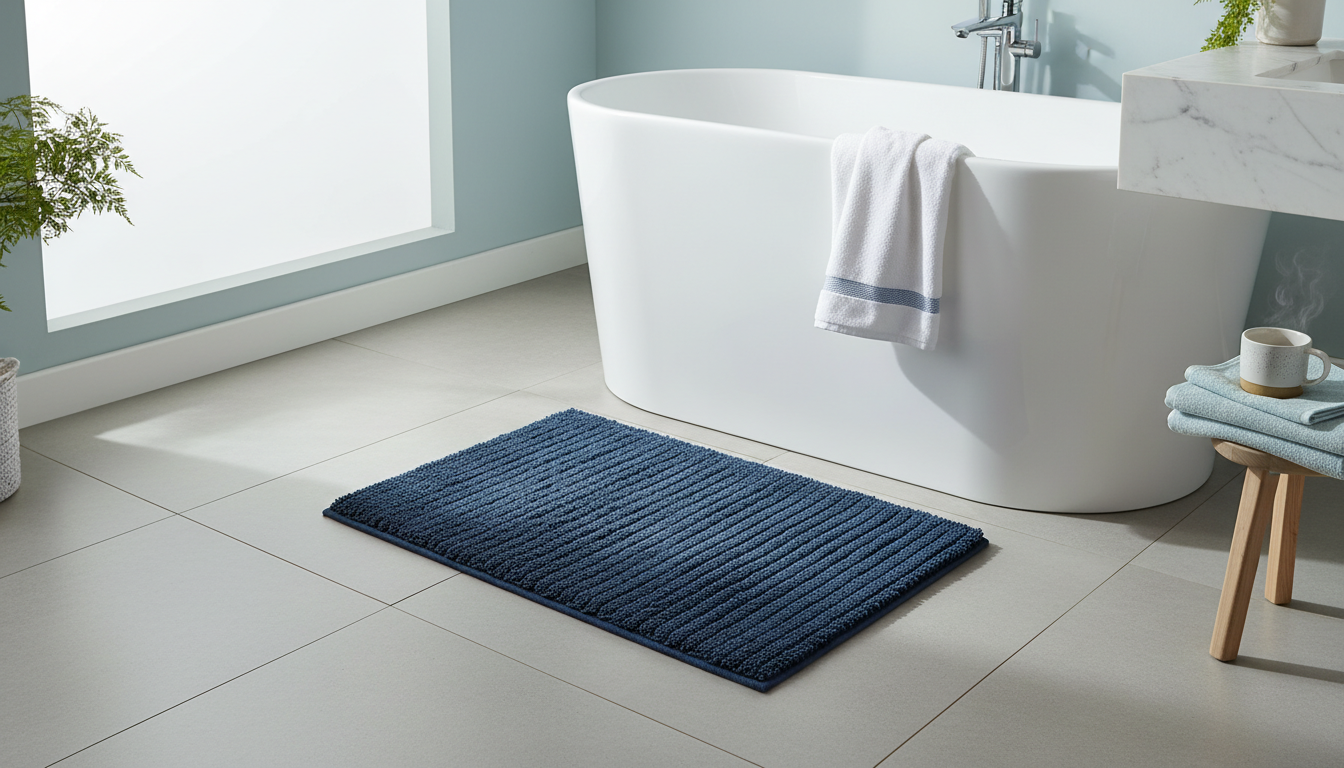
A mat earns its place by stabilizing your step the moment you exit the tub. Backing compounds, surface texture, and thickness all affect traction. Look for a mat with secure footing on smooth tile and grout; a well-designed backing maintains contact without leaving residue, even after repeated machine washes.
| Backing on mat | Grip on wet tile |
|---|---|
| TPR (thermoplastic rubber) | Consistent hold; flexible after washing; common on washable bath mats. |
| Latex-free elastomer | Good for sensitivities; balanced grip; compatible with heated floors at low settings. |
| Micro-suction matrix | High initial tack; excels on smooth porcelain; prefers clean, dust-free surfaces. |
Even the best non-slip mat needs a clean contact patch. Wipe the floor and the backing weekly; this prevents dust films that compromise traction.
If safety is your primary criterion, consider exploring a dedicated anti-slip range to compare grip technologies, thickness, and edge treatments tailored to wet thresholds.
Absorbency on a mat is about volume and speed. Cotton loops store water reliably; microfiber draws moisture quickly; memory-foam cores cushion while capping surface puddles. Choose your blue bath mat by how you bathe—quick showers favor fast-wicking fibers; long soaks benefit from higher total capacity.
| Mat material | Absorbency & dry time |
|---|---|
| Cotton (tufted/looped) | High capacity; moderate dry time; classic plush feel underfoot. |
| Microfiber (split filament) | Very fast wicking; quick dry; lighter handle with stable grip when backed. |
| Memory-foam core + textile cover | Comfort-first cushioning; moderate absorption; prefers good ventilation to dry fully. |
Wash a new blue mat alone the first time to release lint. A low-heat tumble fluffs pile and preserves colorfast fibers.
For maximum water control around showers, compare high-absorbency options in light, ocean, and navy tones to match your tile and ventilation setup.

Size transforms how a mat performs at the threshold. Short mats protect immediate step-off zones; longer formats bridge double sinks or a freestanding tub area. Blue hue then guides flow between fixtures, tying the floor plan together without adding extra textiles.
| Use zone for the mat | Recommended size & tone |
|---|---|
| Shower step-off | 17"×24" light blue for quick-dry and visibility against darker grout. |
| Tub threshold | 20"×32" ocean blue to capture splash along the full lip. |
| Double vanity | Longer runner or 24"×40" navy for clean alignment and fewer seams. |
"A correctly sized blue mat reads as part of the architecture—catching water precisely where it falls and drawing a line that keeps the room organized."
If you’re mapping multiple wet zones, browse other bathroom floor textiles to coordinate a single hue across the tub, shower, and vanity without over-layering.

Start with the wet zone your mat must manage, then dial in shade, fiber, and backing. Use this checklist to focus selection on measurable outcomes: drier floors, dependable grip, and visual calm in blue.
| Mat criterion | What to look for in blue |
|---|---|
| Absorbency | GSM or pile density notes; quick-dry claims for frequent showers. |
| Traction | Non-slip backing; beveled edges; flat-lay behavior after washing. |
| Colorfastness | Stable dyes; wash instructions that preserve the blue tone. |
Prefer a gentle hue that lifts a compact room? See this light sky-toned option here: a pale blue mat for brighter floors.
Need definition around white tile and chrome fixtures? Consider a deep navy variant to sharpen edges without darkening the whole floor.
A blue bath mat moderates glare, signals cleanliness, and shapes perceived room width. Light blue widens compact spaces; ocean tones calm busy surfaces; navy outlines thresholds. Because a mat marks the wet zone, blue’s cool spectrum reinforces freshness exactly where you step after bathing.
A mat targets moisture at the tub or shower with focused absorbency and a non-slip base, while a rug spans larger areas primarily for warmth. If you need extended coverage at a double vanity, an oversized navy format maintains stability without overlayering multiple textiles.
Key gains include safer footing from non-slip backing, faster drying via microfiber or ventilated pile, and visual calm through tuned blue tones. In practice, that means fewer puddles, steadier steps, and a cleaner focal line at the tub threshold after daily showers.
Yes. Gray pairs well with ocean or navy mats for crisp contrast; beige benefits from cooler mid-blues to balance warmth. For a nuanced accent, a petrol-tone choice adds depth without overwhelming neutral grout or stone textures.
Shake out lint between washes; machine wash cold; avoid fabric softener on microfiber; tumble low or air-dry. Clean the backing and tile contact area weekly. These habits preserve quick-dry performance and color stability while maintaining reliable traction on smooth floors.
A 17"×24" or 2×3 rectangle usually covers splash and towel drips. Choose light blue for visibility, or navy for an edged look that guides the step path. If space allows, extend length to 32" for added capture along the door swing.
A blue bath mat is a precision tool: it captures water where it lands, steadies every step, and organizes the room through color. Choose shade for mood, fiber for drying, and backing for hold. For a bolder accent that still calms the floor, explore a teal-influenced pick that bridges warm and cool palettes gracefully.


